Oct 30, 2026
Abstract
Sieve analysis is a commonly used method for determining the particle size distribution of powders and granular materials. The reliability of the results depends on several factors, including sample characteristics, sieve aperture selection, sample loading, sieving motion, and test conditions.
Electromagnetic sieve shakers provide a mechanical approach to laboratory particle separation through controlled electromagnetic excitation. This article examines the basic principles of sieve analysis, the factors affecting measurement results, and the considerations involved in selecting an electromagnetic sieve shaker for laboratory applications.
1. Principles of Laboratory Sieve Analysis
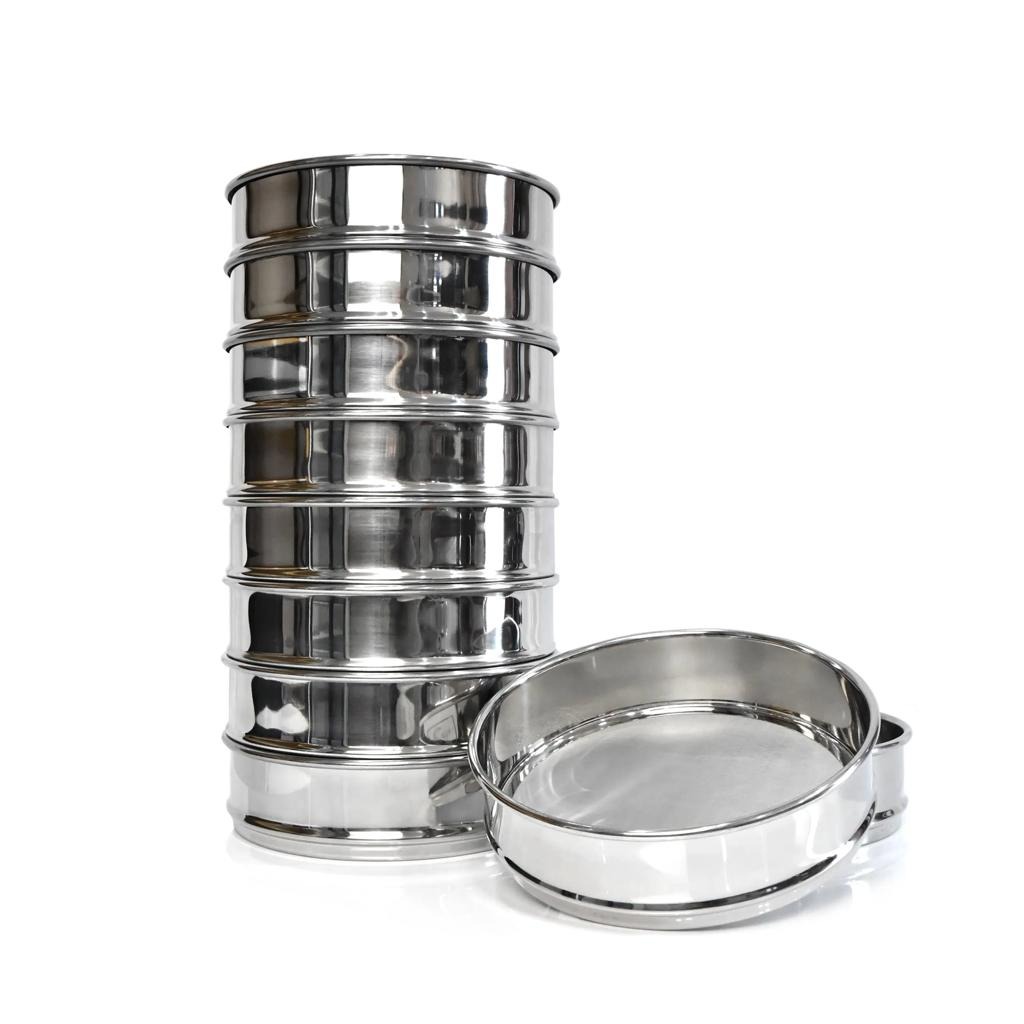
Sieve analysis separates particles according to their ability to pass through defined sieve apertures. A series of test sieves with progressively smaller openings is commonly arranged in a stack, allowing a sample to be divided into several particle size fractions.
During the test, particles interact with the sieve openings through movement, contact, and changes in orientation. Particles that pass through an aperture are collected in the next sieve or receiving pan, while larger particles remain on the corresponding sieve.
The resulting distribution is generally expressed as the mass percentage retained on each sieve or passing through a specified aperture.
It is important to distinguish sieve size from an absolute geometric particle diameter. For irregularly shaped particles, the probability of passing through an aperture can depend on particle orientation as well as its dimensions.
2. Electromagnetic Excitation and Sieving Motion
The motion applied to a sieve stack influences how particles are distributed across the sieve surface and how frequently they encounter the mesh openings.
In vibratory sieving, particle movement can involve vertical displacement combined with lateral or circular motion. This produces a three-dimensional movement pattern in which particles are repeatedly lifted, redistributed, and brought into contact with the sieve surface.
An electromagnetic sieve shaker uses electromagnetic excitation to generate the driving vibration. The vibration is transferred to the sieve assembly, where the resulting motion supports particle separation.
Amplitude is one of the important parameters affecting sieve movement. Changes in amplitude influence the intensity of particle movement and should be considered together with sample properties and sieve loading.
The appropriate operating conditions are material-dependent. A single setting should not be assumed suitable for all powders and particle size ranges.
3. Factors Affecting Sieve Analysis Results
Sieve analysis is influenced by both the physical properties of the sample and the conditions under which the test is performed.
3.1 Sample Representativeness
The test sample should represent the original material as closely as possible. Particle segregation may occur during storage, transportation, or handling, resulting in differences between the collected sample and the bulk material.
Sample mixing and appropriate sample division are therefore important steps before testing.
3.2 Sample Quantity and Sieve Loading
The amount of material placed on a sieve affects the distribution of particles across the mesh surface.
Excessive loading can create a thick particle layer, reducing the available contact area between particles and sieve openings. Insufficient sample quantities, on the other hand, may not adequately represent the original material.
Sample quantity should be considered in relation to particle size, material density, sieve diameter, and the required measurement procedure.
3.3 Particle Properties
Several material characteristics can influence the sieving process:
Particle size distribution
Particle shape and aspect ratio
Bulk density
Moisture content
Agglomeration tendency
Electrostatic charging
Fine powders and particles with strong interparticle attraction may form agglomerates or adhere to the sieve mesh. These conditions can affect particle passage and the resulting size distribution.
3.4 Sieve Aperture and Condition
Sieve selection determines the particle size intervals obtained during analysis.
The selected apertures should cover the expected particle size range and correspond to the required classification intervals.
The physical condition of the sieve is also important. Blocked, damaged, or contaminated mesh openings can influence the separation process. Test sieves should therefore be inspected and cleaned using methods appropriate to their mesh construction.
3.5 Operating Conditions
Vibration amplitude, sieving duration, sample loading, and the characteristics of the material can all influence the observed results.
For comparative testing, the operating conditions should be documented and kept consistent. Changes in test conditions may produce differences in particle distribution even when the original material is unchanged.
4. General Procedure for Laboratory Sieve Analysis
A typical laboratory sieve analysis involves the following stages:
Step 1 — Sample Preparation
Obtain a representative sample from the original material. Mix and divide the sample when necessary.
Step 2 — Sieve Selection
Select the sieve diameters and aperture sizes according to the expected particle size distribution and the required number of fractions.
Step 3 — Initial Weighing
Determine and record the initial sample mass using an appropriate balance.
Step 4 — Sieve Assembly
Arrange the test sieves in the selected sequence, with larger apertures above smaller apertures, and secure the sieve stack.
Step 5 — Sieving
Apply the selected sieving method and documented operating conditions. The sample moves across the sieve surfaces and is separated according to the corresponding apertures.
Step 6 — Fraction Recovery
Collect the material retained on each sieve and in the receiving pan separately.
Step 7 — Weighing and Evaluation
Determine the mass of each recovered fraction and calculate the corresponding mass percentages.
Step 8 — Sieve Inspection
Inspect and clean the test sieves before subsequent measurements.
5. Evaluation of Particle Size Distribution
The results of sieve analysis are generally evaluated using the mass of material retained on individual sieves.
The mass percentage retained on a particular sieve can be calculated as:
Mass Percentage Retained (%) = (Mass of Fraction / Total Recovered Mass) × 100
The cumulative retained percentage is obtained by adding the retained percentages from the largest aperture down to the sieve being evaluated.
The cumulative passing percentage can then be calculated as:
Cumulative Passing (%) = 100 − Cumulative Retained (%)
Results may be presented in a data table or particle size distribution curve.
The mass balance between the initial sample and the recovered fractions should also be checked. Any material loss should be recorded because it may affect the interpretation of the results.
6. Considerations When Selecting an Electromagnetic Sieve Shaker
The selection of laboratory sieving equipment should be based on the intended test method and the characteristics of the material.
The following factors are generally considered:
Selection Factor
Technical Consideration
Sample Characteristics
Particle shape, density, moisture and agglomeration
Particle Size Range
Expected minimum and maximum particle sizes
Sieve Diameter
Available working area and sample loading
Sieve Apertures
Required particle size intervals
Number of Fractions
Number of sieve layers required
Vibration Amplitude
Suitable vibration intensity for the sample
Sample Quantity
Required mass for each test
Test Conditions
Repeatability and consistency of operating parameters
The equipment configuration should be evaluated against the laboratory's actual testing requirements rather than selected solely by nominal machine capacity.
7. Electromagnetic Sieve Shaker: BO-300ESS Technical Example
The LVOBO BO-300ESS is an electromagnetic sieve shaker developed for laboratory particle size analysis, powder classification, and sieve residue testing.
Its operating system uses electromagnetic excitation to generate high-frequency reciprocating vibration and three-dimensional sieving motion.
The main configuration includes:
Parameter
Specification
Model
BO-300ESS
Excitation Method
Electromagnetic
Input Voltage
AC 220V
Input Power
1000 W
Amplitude
0–3 mm, continuously adjustable
Sieve Diameter
200 mm / 300 mm
Available Mesh Range
8–2000 mesh, depending on configuration
Sieve Layers
1–7 layers
Approximate Sample Capacity
5–1000 g per batch
Control Interface
Touchscreen
Recipe Management
Multiple recipe storage and recall
Main Unit Dimensions
D420 × W380 × H295 mm, without sieve stack
The actual sample capacity depends on material properties, particle size distribution, sieve aperture, and testing requirements. The available sieve configuration should also be confirmed according to the intended application.
These specifications describe the equipment configuration. They do not replace the need to establish and validate suitable testing conditions for individual materials.
8. Conclusion
Laboratory sieve analysis involves more than selecting a sieve shaker and a set of test sieves. Sample representativeness, particle characteristics, sieve aperture selection, sample loading, operating conditions, and data evaluation all contribute to the final particle size distribution.
Electromagnetic excitation is one of the available approaches for generating vibratory motion in laboratory sieve analysis. Its application should be evaluated in relation to the material being tested and the requirements of the analytical procedure.
A well-defined testing method, together with appropriate equipment configuration and consistent sample handling, provides the basis for meaningful particle size analysis and comparison between laboratory tests.
Technical Note
This article provides general technical information on laboratory sieve analysis. Specific testing procedures, operating conditions, and acceptance criteria should be established according to the material, applicable test method, and laboratory requirements.
ĐỌC THÊM
 Tiếng Việt
 English
 Español
 Tiếng Việt




 3rd Floor, Building 8, Licheng Science and Technology Innovation Center, No. 188 Taixin Street, Licheng District, Quanzhou City, Fujian Province, China
 Điện thoại
: +86 -13788824251
 E-mail
: lvobo2026@gmail.com
 WhatsApp : +86 -13788824251


 IPv6 MẠNG ĐƯỢC HỖ TRỢ